
How Virtual and Augmented Reality Are Shaping Immersive Learning Environments?
Remember those years you spent at school. It was probably a lot of sitting at desks, reading bulky books, and visualizing what ancient Rome might have been like or how an atom moves. To some extent, such a method of teaching may be regarded as boring.
In the process of our journey to the year 2026, there is one very important aspect that changes dramatically: education. Instead of the old method, which included merely studying and imagining certain events and processes, we are going to learn everything in practice.
The development of this trend is due to two great inventions, VR (Virtual Reality) and AR (Augmented Reality).
What is Immersive Learning?
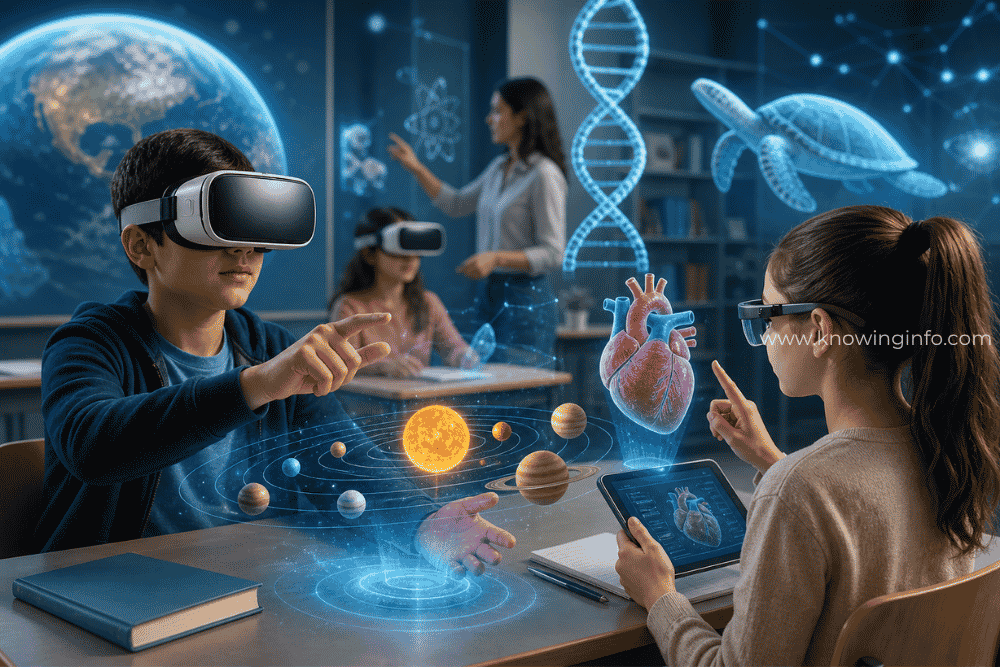
In simpler terms, immersive learning refers to technology-based education that enables students to experience being “inside” their lessons.
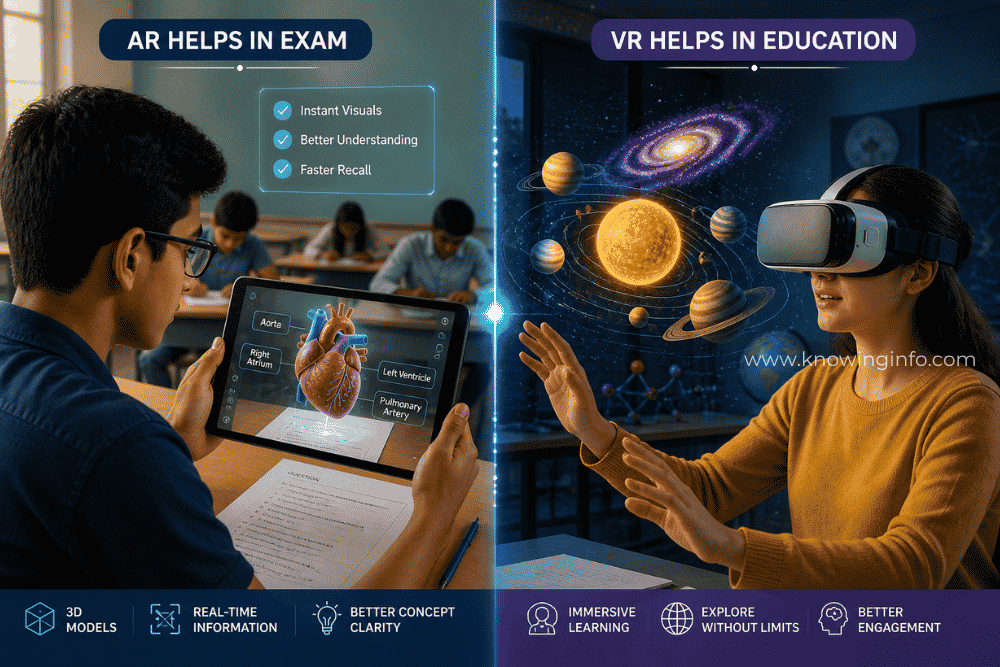
Virtual Reality (VR): It involves using a device like a headset that fully covers the user’s eyes. When worn, the person will be taken into a 3D virtual world where he or she will be able to explore and move around on the moon, inside the depths of the sea, or even inside a human heart.
Augmented Reality (AR): In contrast to virtual reality, which takes you away from your current reality to a different one, augmented reality brings the virtual world closer to your world by creating an overlay of the real world. Through the use of a gadget such as a smartphone or tablet, users are enabled to view 3D models of dinosaurs on their desks at school.
1. Bringing “Impossible” Lessons to Life
Sometimes learning certain lessons would be either too dangerous, too costly, or simply impossible due to distances.
In the year 2026, it’s not only going to be an oral lesson on the Pyramids of Egypt in the history class – it will also include a virtual tour around the hidden chambers that are hard for anyone to access. In the science classes, it won’t matter how expensive or dangerous the materials are to conduct a particular experiment, since students will do everything virtually with zero risk of explosions.
2. Higher Engagement and Better Focus
Another major problem faced by educators is ensuring that students remain engaged in class. Today, with social media and other distractions all around us, spending 40 minutes listening to a teacher seems endless.
Immersive learning solves this challenge by grabbing 100 percent of a student’s concentration. When donning a virtual reality device, there is no possibility of checking one’s phone or interacting with a peer.
One becomes “immersed” in the lesson completely. Research conducted in 2026 found that students who used VR were up to four times more concentrated than their peers in conventional classrooms.
3. Developing “Soft Skills” and Empathy
The immersive learning experience not only applies to sciences and mathematics but can also be used to learn how to relate to people effectively.
Companies have started to incorporate VR into their “soft skills” training programs. For instance, trainees can practice a tough interview session or deliver an address in front of an imaginary crowd. This can be done until they are satisfied with their performance.
Moreover, VR technology can help in developing empathy among learners. In essence, one can assume the position of an individual from another culture or having a physical handicap and view the world through their eyes.
4. Making Education Accessible for Everyone
It is not always possible for schools to afford costly excursions and state-of-the-art laboratory facilities. With the decreasing costs of VR and AR technology, however, these tools are beginning to serve as “great equalizers.”
A student from an isolated rural area will have the same opportunity to visit virtual museums and simulate complex scenarios as someone from an affluent urban environment. Technology is also useful in meeting the diverse needs of learners.
For instance, AR can deliver real-time subtitles to students who are deaf and instant translations to those learning a foreign language.
5. Better Memory Retention
While we usually only retain 10% of information through reading, we can retain up to 90% by doing something.
The process of immersive education involves physical actions that our brain interprets as real experiences.
Therefore, instead of trying to memorize the dates from a textbook, students will remember the moment when they personally visited the signing of the Declaration of Independence. This results in excellent academic performance and a solid knowledge base.
The Challenges We Still Face
Although the future seems bright, there remain barriers yet to overcome.
- Cost: Although headset prices have declined, equipping an entire school with them is still quite costly.
- Content: More educational content that has been “expert-approved” must be developed to make sure the information being seen by the students is accurate.
- The Teacher’s Place: The teacher’s job cannot be replaced. Teachers themselves must be trained on how to use these technologies in the classroom.
Conclusion
Today, VR and AR have evolved from simple gaming techniques. Instead, in the year 2026, they will become crucial elements of education that open up opportunities to learn engagingly. Thanks to them, students can experience the environment around them, which makes education more effective than ever before.
Since the aim of education is always preparation for life, it has never been enough to simply teach facts. Through the application of VR and AR technologies, we are now able to let our students experience everything on a completely new level.