Exploring the Future of Cloud 3.0 and AI-Driven Cloud Services for Scalable Innovation

The speed at which cloud computing is developing is quite rapid. The next breakthrough in cloud computing is Cloud 3.0, which combines the latest advancements in automation, artificial intelligence (AI), edge computing, and hybrid cloud models.
In the new paradigm, cloud computing will not only store data and provide applications but will also think, learn, and adapt. In this simple guide, we will learn more about what Cloud 3.0 is and the importance of AI-based cloud computing.
What Is Cloud 3.0?
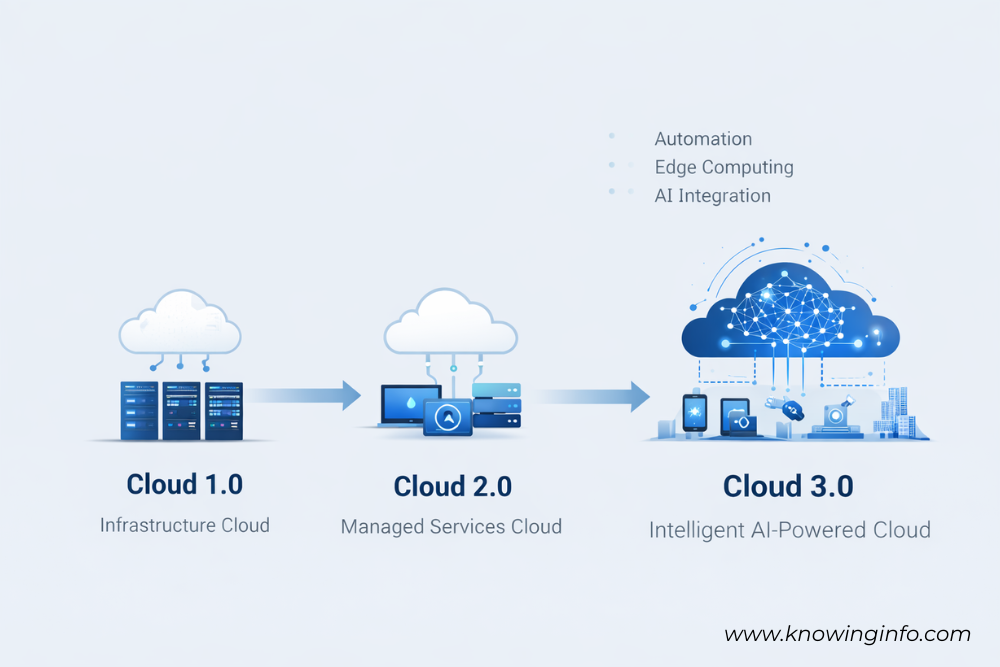
Cloud 3.0 represents the next generation of cloud computing, which goes beyond simple infrastructure (Cloud 1.0) and managed services (Cloud 2.0) to create an intelligent and adaptive environment. In Cloud 3.0:
- Cloud infrastructure self-optimizes through AI and automation.
- Hybrid and multi-cloud models become the norm.
- Data processing occurs not only in a central data center but also in an edge location, closer to where the data is created.
- Security, cost, and compliance are all managed automatically.
In short, Cloud 3.0 is not just about where your applications run; it’s about how well they run.
Why Cloud 3.0 Is the Future of Innovation?
1. AI Is at the Heart of Cloud 3.0
AI is not an afterthought; it’s becoming the foundation of the cloud. AI solutions help cloud infrastructure in making decisions, giving resources, predicting issues before they happen, and providing services in a more efficient manner.
Cloud companies are investing resources into this area, and Gartner forecasts that most businesses will use AI agents for primary business tasks by 2030.
This allows cloud infrastructure to be self-healing, self-scaling, and proactive, which is necessary for innovation.
2. Autonomous Cloud Management
One of the most important trends is AIOps, or the application of AI to cloud and IT operations. An AIOps platform can:
- Identify problems before users report them.
- Suggest or automatically implement a solution.
- Predict future demand and scale before it happens.
This translates to fewer downtime events, faster speeds, and less human intervention, all of which accelerate innovation.
3. Hybrid and Multi-Cloud Becomes Normal
Cloud computing approaches in the past were “cloud-first.” Cloud 3.0 is “cloud-smart.” Instead of depending on a single cloud vendor, enterprises now turn to hybrid cloud (combining private clouds with public cloud resources) and multi-cloud (using multiple cloud service providers) to achieve the best of both worlds on cost, flexibility, and regulatory requirements. This flexibility encourages applications to be more robust and scalable.
4. Edge + Cloud = Real-Time Intelligence

Edge computing affects processing data closer to the user, either on the device or on a local server, thus eliminating latency and the need for high bandwidth. This combination of edge and cloud computing enables real-time AI capabilities.
For example, sensors in a factory can immediately alert operators to a problem, and AI on cloud platforms can immediately suggest a solution.
AI-Driven Cloud Services: What They Are and Why They Matter
AI-driven cloud services are cloud services that integrate AI capabilities into their core services. Some of these services include:
- AI-ready infrastructure for running large models.
- Managed AI services such as machine learning platforms and chatbots.
- Automated security and threat protection.
- On-demand scaling of compute and storage resources.
These services are less complicated, less expensive, and enable businesses, even small ones, to leverage the power of AI without necessarily having advanced technical knowledge.
Benefits of AI-Driven Cloud Services
- Scalability Without Limits
Cloud resources can automatically scale up or down depending on demand. AI enhances this ability by predicting demand and scaling before the system becomes slow or overwhelmed. This is especially important for rapidly scaling applications such as e-commerce sites, analytics platforms, or enterprise AI bots.
- Lower Costs and Improved Efficiency
Pay-as-you-go pricing models mean that you pay only for what you use. AI further optimizes this by stopping unnecessary expenses. This is especially important for many businesses that can now innovate faster with lower budgets.
- Enhanced Security and Compliance
AI is capable of detecting threats and monsters in real-time, securing valuable data. Cloud vendors have started offering AI-driven security solutions that are applicable everywhere, whether it’s a cloud setup, a hybrid setup, or an edge setup.
- Rapid Time to Market
There are pre-built AI services (such as language processing and analytics capabilities) that allow developers to create solutions faster. You can use ready-to-integrate tools that are completely compatible with cloud apps.
Real-World Examples
Cloud and AI infrastructure investments are already being made by major tech companies:
- Microsoft has made huge announcements about cloud and AI infrastructure investments in India, which proves that cloud innovation is a global phenomenon.
- AWS is working on developing highly advanced AI supercomputers and platforms that will be used to support future cloud workloads.
- Cloud startups such as Cast AI leverage AI to automate scaling and minimize cloud expenses for businesses.
Challenges to Address
Cloud 3.0 may bring huge benefits, but certain challenges need to be addressed:
- Data privacy and the use of ethical AI.
- Keeping with regulations across different geographies.
- Energy and sustainability (since AI consumes more power).
Looking Ahead: What’s Next?
By the year 2030, cloud infrastructure will be heavily integrated with AI, not only for analytics but also for operational purposes. Organizations that are early adopters of Cloud 3.0 and AI-based cloud services will be able to achieve a competitive edge and scalability.
Final Words
Cloud 3.0 and AI-based cloud services are the future of digital innovation. They enable cloud infrastructure to be smarter, more adaptive, and more efficient. By adopting the future, organizations can achieve performance and value at a pace that was previously unimaginable.