The Evolution of Money: How Currency Changed the World
Take one of those pieces of paper money from your pocket right now and have a look at it. What exactly are you holding? It’s merely a sheet of paper with some fancy printing on it. You can neither eat it nor use it to keep yourself warm in harsh weather conditions, nor use it as a shelter to live in.
However, billions of individuals wake up every morning, go to work, spend hours there working, and get paid just for those pieces of paper or to change some numbers on the app of their bank.
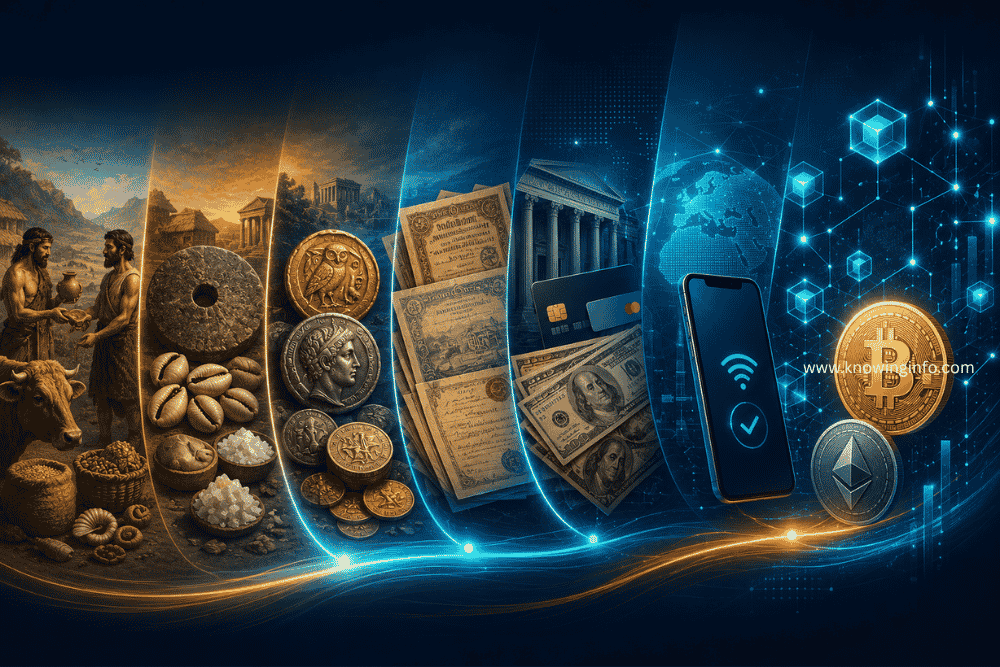
Learning about the history of the emergence of money is not about cramming dull charts of economics; this is truly a history of human trust. We’ve gone through thousands of years from bartering meat and shells to making money from gold, printing pieces of paper, and exchanging electronic data worldwide. Let’s take a journey into that story together, step-by-step.
1. The Barter Days: Swapping Meat for Spears.
Before any form of coinage came into existence, people lived in small groups known as tribes, where their focus was on survival. Tribes in ancient Mesopotamia started exchanging surplus commodities using an act known as bartering—exchanging one item for another.
Let’s say that you just hunted a deer, and your neighbor makes hunting spears out of sharp stones. So you give him a piece of meat in exchange for a hunting spear. Pretty straightforward, isn’t it? But not for very long because barter faced one of the major difficulties called double coincidence of wants.
For example, if you had some milk and needed a pottery pot made up of earth-clay, you had to go around looking for a potter who had surplus pots and wanted your milk. But if the potter needed wheat instead of milk, there was nothing you could do about it.
2. Commodity Money: When Seashells and Salt Ruled the World.
This problem had a simple solution, however. Humans came up with the realization that the direct exchange of goods was not necessary; only something of value to which everybody in the village subscribed was required. This was when the concept of commodity money arose.
In Ancient Rome, for instance, soldiers received their payments in bags full of nothing but pure salt, which is why salary got its name! The people on the Pacific island of Yap used large round limestone disks known as Rai stones, each weighing more than four tons!
However, commodity money was quite flawed. For example, grain could go bad, cattle could die from disease, and who would want to carry a four-ton disk around town just to purchase food?
3. The Metal Revolution: Why Gold and Silver Took Over.
In around 600 BCE, in an ancient and wealthy kingdom known as Lydia (now modern-day Turkey), King Alyattes devised something revolutionary. He melted down a mixture of gold and silver, referred to as electrum, and then stamped it with his seal of a roaring lion. These were known as the Lydian Staters, the world’s first coins of standardized value.
Coins transformed the way commerce was conducted; the stamping guaranteed the precise weight and purity of the metal, eliminating the need for traders to weigh out gold using a scale every time.
Coins were portable, did not decay or spoil, and lasted indefinitely. However, as international commerce became increasingly common and lucrative, traders had to move tons of metal coins, packed inside large wooden chests along rough and dangerous roads and seas infested with pirates.
4. The Paper Shift: How Carrying Receipts Replaced Heavy Gold.
In the thirteenth century in China, the ruler Kublai Khan of the Mongols tackled the issue of heavy metals with an innovative solution. He issued paper money that was actually notes made from the inner bark of mulberry trees and stamped them with his royal signature. He mandated everybody in his domain to use paper money.
A few centuries down the line, the same thing happened in Europe with the goldsmiths issuing receipts to customers who deposited their gold coins in the safety vault of the goldsmiths. These receipts were the early version of an “IOU.”
Merchants soon discovered, “Why should I travel all the way to the vault, withdraw heavy gold coins, and carry them to the market when I have this piece of paper to purchase what I want?” And that is how paper money became popular currency.
5. From Gold Standard to Numbers on a Screen.
Until recently, each dollar or pound was tied to gold physically stored in a government vault. Essentially, one could have exchanged the paper money for actual gold.
However, in the 20th century, governments severed the link to the precious metal altogether. The money became fiat, that is, money created and sustained by governmental decree and the confidence of people.
In the 1980s and 1990s, money was yet again transformed in its huge leap into the computer network age with the help of debit cards and electronic wire transfers. Finally, in 2009, Satoshi Nakamoto created Bitcoin, which was the first decentralized cryptocurrency operating via mathematical algorithms rather than a central bank.
Frequently Asked Questions.
- Which was the Earliest Form of Money Used by People?
Prior to any official currency being created, societies would conduct exchange via barter, which then developed into exchange based on commodities such as salt, cowrie shells, cattle, and crops.
- Why Did Nations Abandon Gold Backing of Their Currency?
Governments took paper currency away from being backed by gold during times of financial hardship and war so as to enable central banks to manage the money supply and avoid economic standstill.
- What Really is Fiat Money?
Fiat money refers to the paper money issued by governments, including the US dollar, Euro, or the Indian rupee, which lacks physical gold as its backing and whose value depends on trust.
- What was the Reason for Using Coins Instead Of Other Goods?
Coins were never subject to rotting; they were easy to put into one’s pocket; they could be easily divided into precise fractions, and they had an official mark of the king certifying their precise weight and composition.
- How Can Money Exist if it Cannot Be Physically Touched?
Digital money functions through collective social faith in the reliability of the accounting system within the bank that verifies transactions to be of monetary value.
Key Takeaways.
- Barter Had Its Limitations: The difficult situation of needing both parties to want what each one had made people develop the concept of money.
- A Gradual Evolution: Money has always been evolving from tangible goods like food and animals to metallic disks, paper documents, and computer pixels.
- The Force of Consensus: No matter whether it was bartered as salt, gold, or digital currency, money is simply effective because everybody agrees that it is.
- Unending Innovation: From the first Lydian coins to the current blockchain ledgers on computers, our approach towards handling and exchanging money has been changing.
Conclusion.
Money is humanity’s greatest tool for bringing together disparate tribes and making civilization possible. Even in the age of digital payments and virtual currencies, money still depends on our common belief in its value system.
History makes us understand where future business is going. Isn’t it fascinating that money has come from cowrie shells to cell phones?