
What Is GDP and Why Is It Important for the Economy?
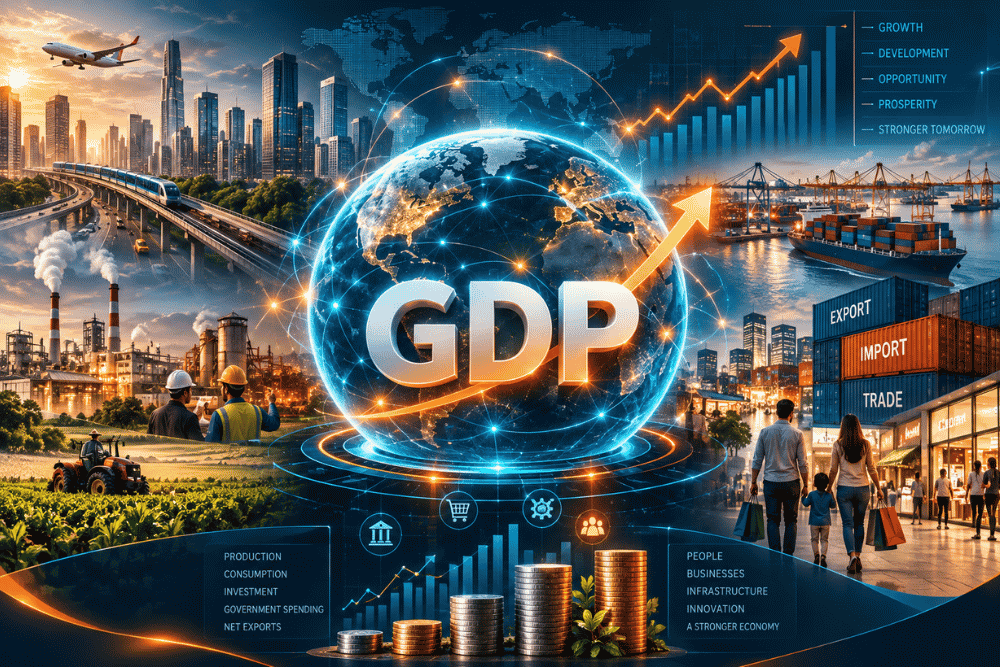
Imagine yourself going to the nearby tea stall early in the morning and paying ₹10 for a cup of tea. The shop owner will use this money to buy milk and ginger from a dairy farmer who, in turn, hires a local mechanic to repair his tractor. This chain of events happens through just one small transaction, but imagine what would happen if this chain is repeated millions of times in millions of other shops, IT offices, textile factories, and hospitals throughout the whole country.
When the total value of all these finished products and services is added to get one large number, then you have GDP [Gross Domestic Product]. It serves as a fitness tracker for the financial well-being of a nation and shows whether there is any business activity that is thriving and creating chances or not.
What Is GDP and How Is It Defined?
GDP, or Gross Domestic Product, is defined as the total of all the values of the final products and services that are produced by a nation in a particular period of time, such as a year or quarter. It is used to measure the size and performance of the economy of a nation.
The word “final” is important here. The calculation of GDP uses only the final product in order not to repeat the value of the product. For example, if raw material is used for manufacturing a product, then its value is already included in the final cost of the product. In simpler terms, GDP measures how productive a nation is at a particular period of time.
What Is the Difference Between Nominal and Real GDP?
At first, Nominal GDP and Real GDP seem to be similar terms, but they reveal different aspects regarding economic growth. The most important distinction between the two is the treatment of changes in prices.
Imagine that the factory manufactured 100 items last year and manufactured 100 items this year as well. But the price of every item increased this year. This will create an impression that the value of manufacturing increased although no additional manufacturing was done. This is where the concepts of Nominal GDP and Real GDP become important.
- Nominal GDP: It is calculated at the current price level. In other words, if there is any increase in the price level due to inflation, then Nominal GDP increases without any actual increase in output.
- Real GDP: By eliminating the impact of inflation through the base-year price level, we can determine Real GDP. This helps us understand the actual change in production of goods and services.
Thus, Nominal GDP growth is determined based on current prices, whereas Real GDP growth is the measure of actual growth in production of goods and services.
Why Is GDP Important for Understanding Economic Growth?
GDP is important in helping to determine whether the economy of a particular nation is expanding, contracting, or stagnating. GDP provides a good summary of the value of goods and services that have been produced in the country within a given period.
The increase in the level of GDP implies that there are increased levels of production of goods and services in the economy and the growth of economic activities. In contrast, a decrease in GDP means that there is a decline in the level of economic activities in the economy. In this way, it is possible to determine whether there is economic growth.
Why Is GDP Important for Jobs, Wages, and Everyday Life?
GDP may appear like just an economic figure, but it can affect lives in various ways, including through the economy’s development and increased production and sales of products by firms.
More Employment Chances: As there is increased demand for goods and services, businesses require additional staff to handle their increased activities, leading to more job opportunities in various sectors.
Higher Salaries and Career Development: Where businesses thrive, they afford higher salaries and even career development chances for their workers.
Improved Public Facilities: The rise in economic performance helps the government to earn through taxation. The tax revenues earned by the government could be used to develop public facilities like transport facilities, roads, and education facilities.
In other words, an increase in GDP growth can help generate employment, income sources, and improvements which may contribute to people’s lives.
Key Takeaways
- Score Card: It is an accurate, thorough measure of how much work and production is taking place within the country.
- Four Growth Factors: It shows the overall direction of household spending, private investment, government infrastructure building, and exports and imports.
- Real Production Focus: When we study real production, we will see actual development and not an increase in prices due to inflation.
- Real Life Significance: An economy that succeeds will result in more jobs, better pay, and modern facilities for citizens.
Conclusion
In the end, GDP is more than just a simple figure that you come across in newspaper headlines or news articles. GDP is the tale of millions of individuals who work hard, earn, and prosper.
It could be a farmer who reaps a harvest; it could be an engineer designing software; it could be an owner of a small business dealing with customers every day – all of these efforts contribute to the progress of the country. By knowing the mechanics of GDP, you understand where the economy is heading – it helps you to find out what path to take for your future and career.
While economic figures may be written in books, their true value is generated by ordinary individuals.
Frequently Asked Questions
- Why would an ordinary individual be concerned with national GDP?
Because it is directly related to your finances. If the economy is growing, firms will make higher profits and recruit more personnel, leading to salary increments. If the economy declines, layoffs will be on the increase, and it will be hard to get employment.
- How does Nominal GDP differ from Real GDP?
Nominal GDP measures the value of production using existing market prices, while real GDP takes into account the effect of inflation, showing whether the country increased its production and services.
- What is meant by GDP per capita?
GDP per capita refers to the average amount of GDP produced per individual within a country. This figure is arrived at by dividing the GDP of a nation by the number of individuals living within that nation.
- Why does India have a high GDP while per capita income is relatively lower?
India has a high GDP since it has a very big economy. However, when you divide this GDP among over 1.4 billion people, it ends up being low on a per capita basis.
- What is the difference between GDP and GNP?
While GDP considers production within the territory of the country regardless of the ownership of businesses, GNP looks at income earned by a country’s people as well as firms both domestically and abroad.