What Is El Niño and How Does It Affect Weather Around the World?
Think about how changes in ocean temperature that happen hundreds of miles away can affect the climate in your nation. Well, this may sound strange to you, but it is a reality in the case of El Niño. This natural sensation starts in the Pacific Ocean and affects many parts of the world.
El Niño is believed to be one of the most important climatic patterns in the world. Why? Because it affects everything, from weather to farming practices, water supply, ecology, and economy in different regions. While some areas will be dealing with too much rain and floods, on the other hand, others will have extreme droughts and high temperatures due to El Niño.
In this article, we will look at what El Niño is, how it occurs, why it happens, and how El Niño impacts different regions.
What Is El Niño?
El Niño is a natural climate pattern of the Pacific Ocean’s surface temperature near the equator. While a small change in ocean temperature may not seem like a major deal, it can start important changes in weather patterns around the world.
This name, El Niño, comes from the Spanish word “The Little Boy” or “Christ Child” because fishermen in Peru first used the term. After all, the warming waters often seemed around Christmas.
El Niño is just one part of the climate system known as the El Niño-Southern Oscillation (ENSO), which consists of El Niño and its opposite phase called La Niña.
Quick Facts About El Niño
- Happens in the tropical Pacific Ocean
- It usually occurs every 2 to 7 years.
- Can last from 9 to 12 months
- It can impact global weather patterns
- Constantly monitored by climate researchers
How Does El Niño Create?
First, look at the regular processes that arise in the Pacific Ocean just to better understand the cycle of El Niño creation.
Regularly, the trade winds blow east to west in the Pacific Ocean, pushing warm waters towards the regions of Indonesia and Australia. At the same time, cooler water increases from deeper parts of the ocean near the coast of South America.
During an El Niño event, these trade winds weaken. As a result, the warm water that is focused in the western Pacific starts moving eastward. As this warm water circulates across the central and eastern Pacific Ocean:
- Ocean temperatures rise.
- Rainfall patterns shift.
- Air pressure changes.
- There is a disturbance in atmospheric circulation.
The problem could originate from the ocean, but it could affect weather patterns throughout the world.
What Are The Factors Behind El Niño?
It is said that El Niño comes about due to the natural phenomenon of the interdependence between the atmosphere and the oceans. This sensation is created by the interplay between oceanic current flow and wind patterns.
This feeling is seen to be part of the climate cycle of nature on Earth. Even though climate change is not a direct cause of El Niño, it only improves certain factors, such as heat waves and heavy rains.
How Does El Niño Affect Global Weather Patterns?
One of the reasons why El Niño receives so much attention is because of its ability to shift weather patterns on more than one continent.
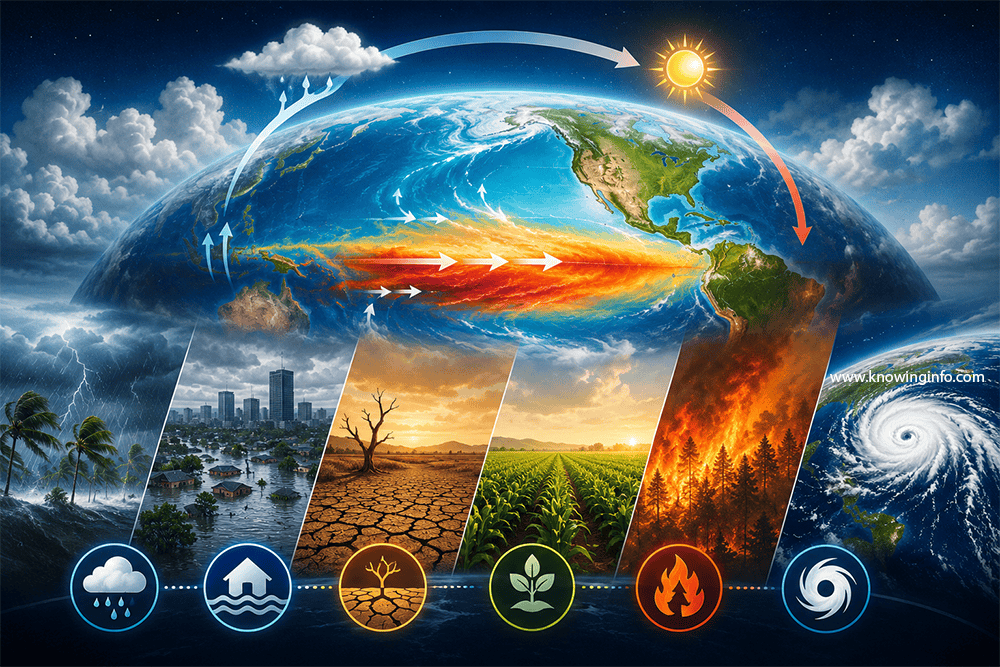
Some areas become very wet, while some get extremely dry. The increase in global temperatures is another common effect experienced during El Niño years. Weather changes commonly seen during El Niño years include:
- Heavy rainfall and floods
- Extreme drought in specific areas
- Increased temperatures
- Hurricanes and storms
- Higher risk of wildfires
Because the atmosphere is connected globally, even a change in one ocean basin can have general results.
Effects of El Niño Around the Globe
- Wet conditions and mild winters would be common in North America.
- South America will see heavy rainfalls, flooding, and disturbances in fishing.
- Asia will experience reduced precipitation and drought.
- Australia will be under drought situations, a lack of water, and more wildfires.
- Either drought or extreme rainfall can happen in Africa, based on location.
The consequences on Europe are less severe, though weather changes can still take place.
How Does El Niño Affect India and the Monsoon?
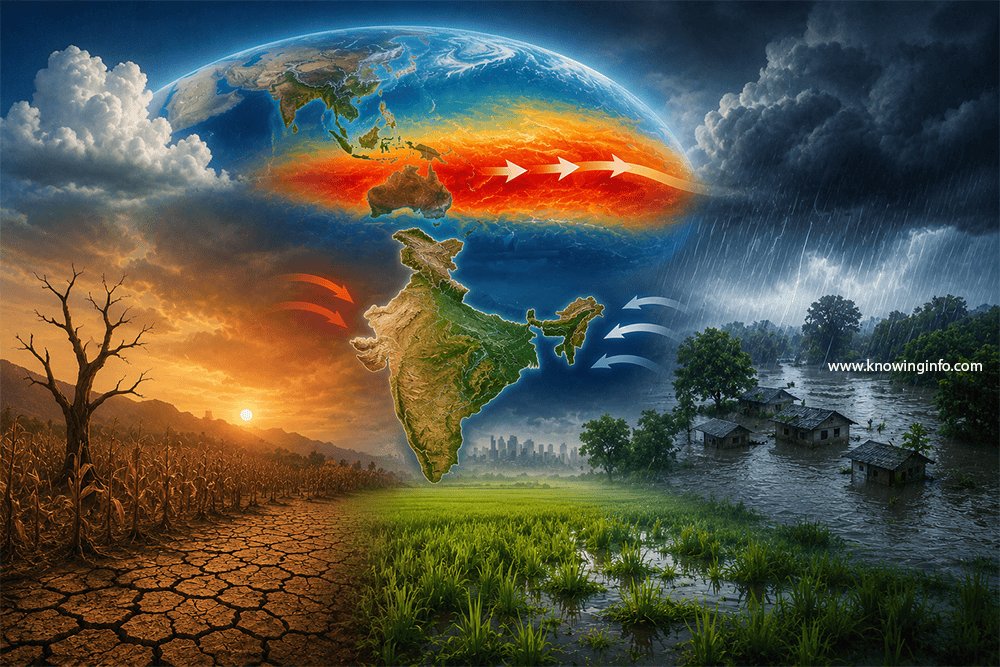
El Niño has importance for India because of its connection to the Southwest Monsoon. In many cases where there has been an El Niño occurrence, the monsoon season can experience lower-than-normal rainfall.
It could bring problems for agricultural activities, irrigation, and other matters that are dependent upon seasonal rainfall.
Some of the potential effects include:
- Reducing monsoon rainfall
- Lower yields in farming
- Decreasing reservoirs and groundwater supplies
- Greater pressure on water supplies
- Financial problems in agricultural regions
However, it should be noted that El Niño does not necessarily bring drought but may contribute to poor monsoon seasons.
Impact on Agriculture, Environment, and the Economy
The agricultural industry is among those that suffer much from El Niño. Altered levels of rain and temperature could affect crop outcomes, push food prices to rise, and lead to a lack of water in farming areas.
Environmentally, it may affect fish populations in marine environments. In addition, high sea temperatures induce coral bleaching. Dry weather leads to forest fires in some places.
The economic impact of El Niño may include food shortages, reduced energy production, transport difficulties, and damage to infrastructure. Major El Niños have cost the global economy billions of dollars.
El Niño vs. La Niña
However, the opposite stage of the sensation is referred to as La Niña. Where El Niño is characterized by unusually warm Pacific Ocean water temperatures, La Niña is marked by unusually cool Pacific Ocean water temperatures.
Although both El Niño and La Niña affect world weather. So, it is necessary to note that their impacts on the weather often vary. For example, El Niño leads to weak monsoons in India while La Niña brings about strong monsoons.
How Are El Niño Events Predicted By Experts?
There exist methods developed by scientists that help in studying oceanic and atmospheric phenomena. With improved surveillance systems, experts are able to predict the coming of El Niño events even weeks before it happens.
FAQ
- What is El Niño?
It is this feeling that gives rise to odd, warm water from the Pacific and thus affects the weather patterns globally.
- How long does El Niño last?
The duration of most El Niño events is between 9 and 12 months.
- How frequently does it happen?
It occurs once every 2 to 7 years, on average.
- Is El Niño responsible for global warming?
No, although it can affect the global temperature rise.
- What is its impact on India?
It generally raises the probability of deficient monsoon rainfall and may affect agriculture and water resources.
- Is El Niño harmful?
Yes, as it may lead to floods, droughts, heat waves, and financial loss.
- Can it be predicted by scientists?
El Niño can easily be predicted by scientists with months to spare through climate models and ocean monitoring tools.
- How does El Niño contrast with La Niña?
While the former is characterized by warm ocean temperatures, the latter is marked by cold ocean temperatures.
Conclusion
Though El Niño might originate in the Pacific Ocean, its impacts go well beyond this region. The warming of the ocean and the alteration of the atmospheric system affect the weather, agriculture, ecology, and economy of the whole planet.
Information on El Niño gives one an advantage in terms of dealing with extreme weather phenomena, distribution of resources, and comprehension of the interdependence of the processes on Earth.
Whether you are a scholar, farmer, politician, or simply an interested individual, learning about El Niño will be beneficial for you.