How Quantum Computing Works and Why It Will Change the World.
Imagine yourself getting trapped inside a huge maze. For you to find the escape route, you need to go through one corridor, reach a dead end, retrace your steps, and then move onto another route.
This goes on and on until you finally discover how to get out of there. This is how today’s computers or cell phones solve problems; they are intelligent machines, but they have the limitation of processing one route after another.
Can you imagine how amazing it would be if you flooded the whole maze with water? Water will take all corridors simultaneously, make turns, reach dead ends, and immediately locate the exit point.
This is the real magic of quantum computing. It is not a simple enhancement to our existing technology, but an entirely different approach to handling data.
Learning how quantum computing works and what impact it will have in the future on our abilities is essential in order to understand where we are going. This article will explain to you bout quantum computing so that you can easily understand everything without the need to jump to another article.
What Is a Quantum Computer anyway?
To understand how the functioning of quantum computers work, you need to learn about the way conventional computers process information first. Regular devices make use of little switches which are called bits. Bits are very simple; their possible states are only two: they can be off (0) or on (1). All the apps you launch, all the videos you watch, and messages that you send consist of billions of such zeroes and ones.
And with a quantum computer, forget all of the old rules. Quantum computers use qubits, which stand for quantum bits, rather than normal bits. Due to some really neat physical principles, qubits do not have to decide on being either a 0 or a 1; rather, they can be both at the same time!
The Secret Sauce: Superposition and Entanglement.
Two ideas which make quantum computers possible, and while they may sound fanciful, they are entirely real.
1. Superposition (Spinning Coin)
Imagine a coin lying flat on a table; it will be either heads up or tails up. This represents a classical bit of information. But what happens when you start spinning that coin? Is it heads or tails? It is both because during the process of spinning, it is in an uncertain state and both heads and tails simultaneously.
This idea of being in multiple states is known as superposition. As qubits can remain in this uncertain state, a quantum computer is able to check multiple options at once rather than checking each one of them individually.
2. Quantum Entanglement (Digital Twin)
But this is not all, as qubits can become interrelated through entanglement, which makes them dependent on one another. When two qubits are entangled, changing the state of one will instantaneously change the state of the other, no matter where it is located. In a quantum computer, this means that all qubits can function as a unified whole, increasing the performance of a quantum computer exponentially with every qubit added.
What Do These Machines Actually Look Like?
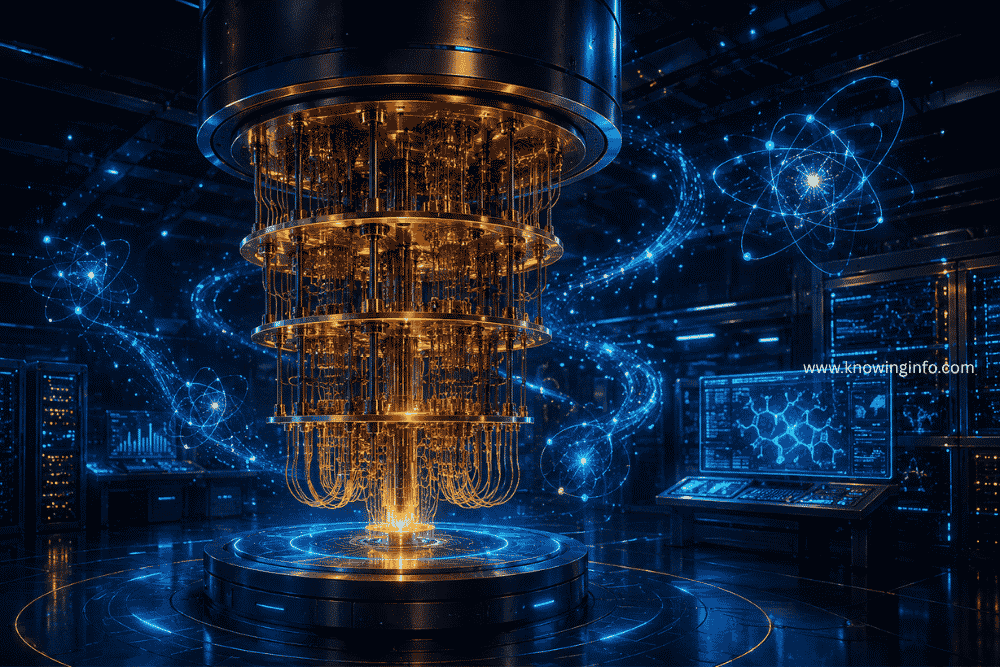
If you entered a technology lab with the intent of finding a quantum computer, you would not be able to find a screen, a mouse, or a metallic case. Instead, you would be facing an elaborate and grand machine that resembles a huge gold chandelier with copper wire and glass tubes.
This is because qubits are very delicate, and any slightest change in terms of external heat, vibration, or a Wi-Fi signal may mess up the computation, causing the whole process to collapse.
This is why the entire structure serves as an enormous super freezer, maintaining the core temperature lower than outer space itself, which is approximately minus 273 degrees Celsius!
The Race for Quantum Supremacy.
The world had always considered such machines to be an outrageous idea until October 2019, when Google made waves around the globe by claiming to have succeeded in attaining Quantum Supremacy.
The feat was accomplished using a 53-qubit machine dubbed Sycamore to complete a mathematical computation in 200 seconds. For some context, the strongest supercomputer that the planet has would take about 10,000 years to achieve the same result.
The action clearly demonstrated that quantum computing is not only possible but can even leave behind traditional silicon-based processing units in its wake. Presently, big firms such as IBM, Microsoft, and Intel are investing millions in scaling up the process.
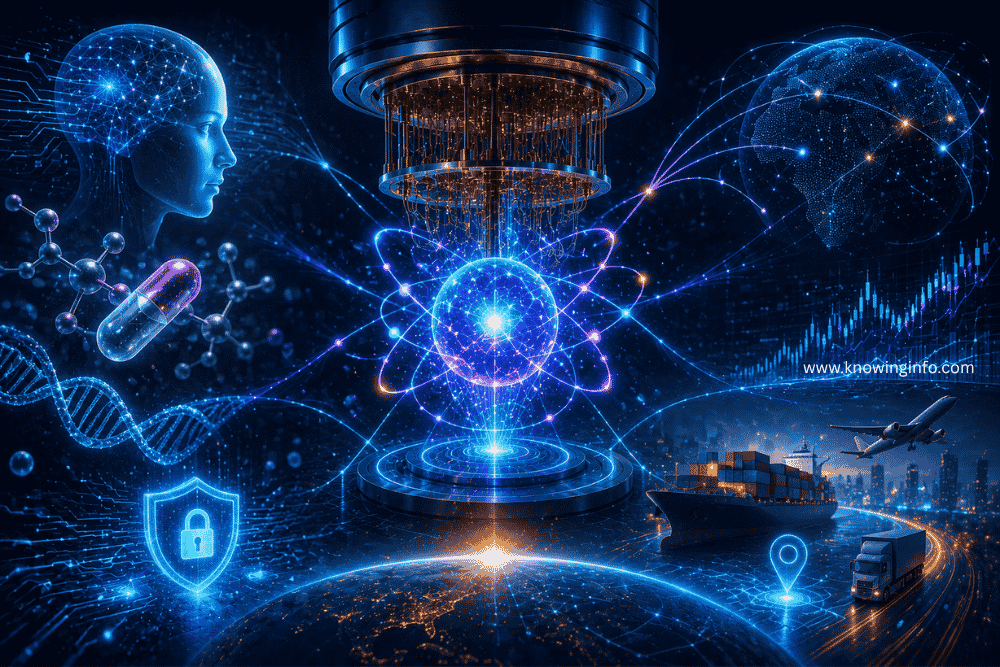
Why This Will Completely Change Our World?
The reason for developing quantum computers is not to increase the speed of loading images into your social network feed or run a better version of your favorite video game. They are developed to tackle big problems in the real world that will make a standard computer collapse.
Creating Cures Faster: The discovery process of a novel lifesaving drug takes over ten years of lengthy and costly experiments. However, the quantum computer can perform simulations of molecular interactions instantly and assist scientists in inventing new drugs within days, not years.
Upgraded Artificial Intelligence: Contemporary artificial intelligence needs vast amounts of information and weeks of computations to master new skills. Quantum computers can manage such large data sets in no time and make AI algorithms much more intelligent.
Fixing Global Logistics: These computers are able to evaluate all the possible routes of transportation simultaneously and save energy, optimize global logistics, and even forecast dangerous weather conditions weeks ahead of time.
The Catch: The Big Security Problem.
This amazing technology comes with its own dark side. Our current internet security systems, such as banking passwords, personal instant messaging apps, and database systems used by businesses, all rely on mathematical problems that are impossible for normal computers to solve.
Since quantum computers can try out several possibilities in an instance, they will be able to easily penetrate these security systems within a few minutes. However, you should not worry because security engineers are currently developing post-quantum cryptography, which is a set of highly secure passwords that will be developed before this technology becomes widespread.
Frequently Asked Questions.
- What is quantum computing, explained simply?
It’s a new way of computing based on weird physics that makes quantum computers capable of solving big, complex problems way faster than any classical supercomputer.
- How is a qubit different from a regular bit?
While a bit can either be 0 or 1, a qubit can be both simultaneously, so it is capable of handling several computations at once.
- Will I have a quantum computer on my desk in the future?
Unlikely. Quantum computers take up a lot of space and require special low temperatures to work. So you will probably access the processing power of quantum computers remotely from the cloud, whereas your phone and laptop will do the regular job.
- Are quantum computers able to crack my password?
Yes, they might be in the future, but right now tech companies develop new quantum-proof keys to protect all the passwords and data.
- When can we expect quantum technology to benefit regular people?
You will definitely feel it in about 5-10 years from now. You will not have it in your apartment, but you will enjoy the results of its operation: saving lives through medicine and highly accurate weather forecasting.
Key Takeaways
- Mind-Blowing Speed: Qubits allow quantum computers to execute thousands of calculations simultaneously.
- Proof of Concept: Key milestones such as Google’s historic experiment prove that these machines can easily blow past the capabilities of ordinary supercomputers.
- Upgraded Technologies: These machines will transform medicine, artificial intelligence development, and logistics.
- New Security Measures Required: Our entire world of digital security must be upgraded to deal with the speed of these machines.
Conclusion
Quantum computing is an enormous leap in problem-solving. By ditching straightforward zeroes and ones and embracing the more fluid world of quantum physics, we are finding solutions to questions that have not been able to be answered before.
Although we are only at the beginning stages, reminiscent of the 1950s era of large-scale computers, once this technology matures, it will revolutionize the medical field, give artificial intelligence superpowers, and solve the world’s engineering disasters. Witnessing a frozen golden chandelier complete a 10,000-year job in just four minutes confirms that science fiction has arrived.