How AI Tools Adapt to Individual Student Learning Paces and Improve Personalized Education
Think of a class of thirty people. The teacher is teaching at one speed, but everyone’s brain has a different way of working. Like, A few children may complete the task and get bored; some may follow the teacher, while some others may not understand anything due to a lack of understanding of even a single step.
Years back, the concept of school was treating every student as parts in a factory line, meaning that everyone would be required to work at the same speed as the other.
However, everything has changed nowadays due to the modern concept of personalized learning through AI technology. In this blog, we will explain how these smart tools work and how they help students succeed.
Key Takeaways
- Smart programs use hesitation and mistakes to make real-time adjustments in difficulty level.
- Students move forward only when they have mastered the concept, ensuring that no knowledge gap is created in the future.
- The spaced repetition system ensures that old concepts come back just before they are about to be forgotten.
- Automation of drilling and assessment enables teachers to devote time to mentoring.
- AI personalizes the pace for each student, while human teachers inspire and mentor.
How Smart Tools Know When to Slow Down or Speed Up?
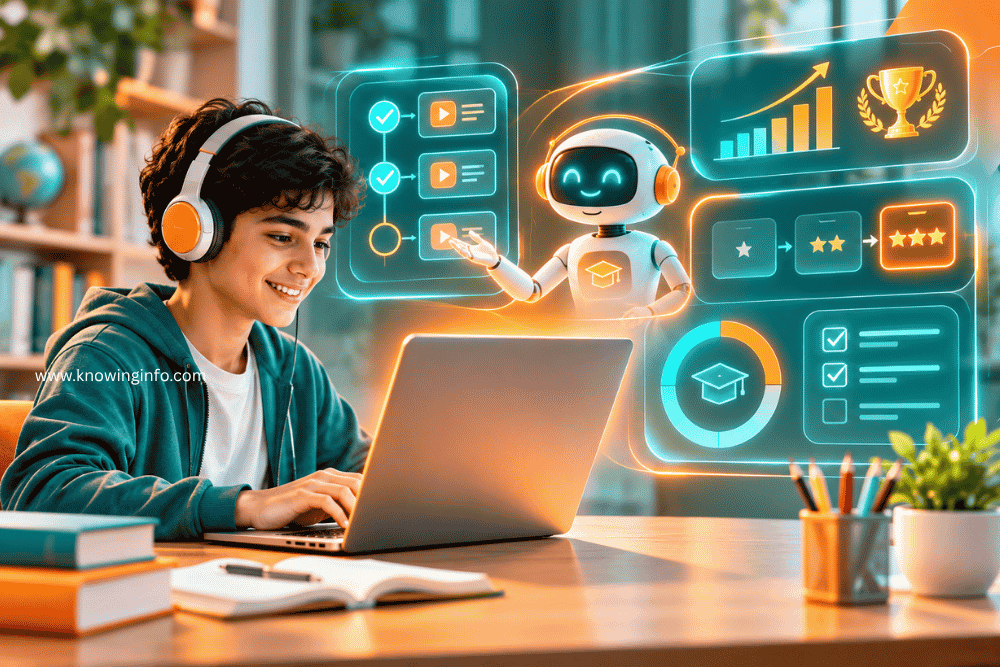
The AI program measures your pauses, your wrong answers, and what you don’t understand, and immediately makes your next question harder or easier based on your pace.
Wherever app uses AI-powered personalized learning; it measures much more than your wrong and correct answers. It watches everything you do:
- Pause Time: It measures the amount of time, in seconds, for which you have been concentrating on the question before answering it.
- Error Types: It recognizes whether you have committed a mistake by accident or that you really do not comprehend the lesson.
- Confidence: It assesses if you are able to solve a problem consecutively two or three times.
Imagine it as a smart map on your smartphone. If you make an incorrect turn while solving a mathematical problem, such as understanding fractions, AI-powered personalized learning will immediately recalculate your path for you. It will go back a bit, explain what you missed, and bring you back to the main topic.
How AI-Powered Personalized Learning Changes Normal Classrooms
The benefits of these tools include ensuring that each student is only able to progress if they have understood the subject matter, thereby preventing them from being left behind in the future.
In a traditional classroom, the teacher is forced to take up chapter four next week, despite the fact that you haven’t understood chapter three. This is a knowledge gap that will affect you in the future.
Using AI-powered personalized learning means there is no need for you to pretend that you get something to stay up to speed. On the other hand, it makes the process of learning enjoyable since the problems are neither too difficult for you to give up nor too easy for you to be bored.
How Smart Apps Stop Brain Tiredness and Help Memory
Intelligent applications notice when your brain starts to feel tired, offer fast breaks or interesting videos, and revise previously learned material just before you forget it.
No one can concentrate for hours straight without running out of steam. Books do not know when you are tired, but personal learning powered by AI does.
The system recognizes if your responses are slow or inaccurate. The learning system could replace a lengthy page of reading material with a brief video or even appear on the screen with an encouragement to take a break and hydrate yourself.
On top of that, AI-powered personalized learning uses a trick called spaced review. It brings back a fact from two weeks ago at the exact moment your brain is about to forget it, locking the memory in place for good.
How Teachers Benefit from Smart Learning Tools
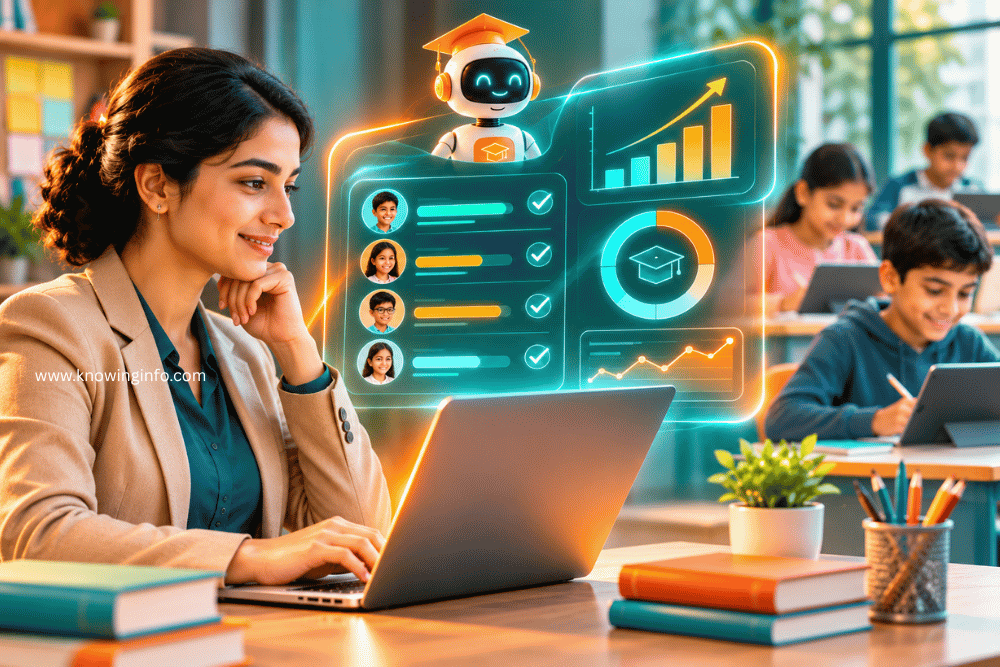
AI technologies perform the routine task of homework grading and provide teachers with straightforward charts of students requiring additional assistance. This gives more opportunities for conversations with students individually.
It is possible to assume that computer technology may completely replace teachers, which is far from the truth. Real-life AI-assisted personalized learning allows teachers to have superhero powers.
For example, instead of spending the night grading worksheets, the teacher is able to look at the dashboard and see that, thanks to personalized AI-assisted learning, five students need help with long division. At the same time, the other three are ready to move further.
With the help of AI-powered personalized learning, teachers can actually spend time talking to small groups of students. With the adoption of AI learning more in schools, studying becomes an enjoyable activity.
Conclusion
The traditional classroom assumed that every single child had to learn precisely the same information at exactly the same rate, but that is not how life really works. When you make all the children run the race at the same pace, they get discouraged.
AI-powered personalized learning makes education much more personalized because it addresses every student at his level. Learning is possible for every student; he only needs an appropriate tool that works in accordance with his pace.
Every student learns differently, and that is okay. When our tools adapt to our pace, learning becomes a journey we can actually enjoy.
FAQs
1. How Do Adaptive Algorithms Tell If a Student is Guessing or Has Truly Mastered a Concept?
The system measures the time taken to answer and also whether you can solve the same problem using new data. If you answer an elaborate question in two seconds, the system will flag your response as a guess, thus giving you another test to measure your knowledge.
2. What Happens When a Student Repeatedly Gets the Same Question Wrong?
The system responds by giving the user an easy hint to take note of, walking them through the problem, or giving them a fast tutorial video. If the difficulties persist, they get notified on the teacher’s dashboard for one-on-one intervention.
3. How Does Adaptive Pacing Stop Advanced Students From Rushing Ahead Without Deep Understanding?
Rather than just promoting students to the next grade level, the platform engages them in critical thinking skills and open-ended project-based learning in real-world situations. This guarantees that they have fully understood the concept before moving on to new lessons.
4. Can these Adaptive Platforms Connect Directly With Systems Like Canvas or Google Classroom?
Yes, they use the same standard integrations to integrate with educational platforms like Canvas and Google Classroom. This ensures that the student’s mastery score and recommended practice drills are aligned.
5. How Do AI Tools Grade Subjects Without Clear Right-Or-Wrong Answers?
They make use of Natural Language Processing (NLP) for assessing the quality of an argument, its supporting evidence and vocabulary. The software provides instant feedback on both the structure and style of writing without grading the work automatically.