
How Does the Immune System Work? Understanding How Your Body Fights Invisible Threats Every Day
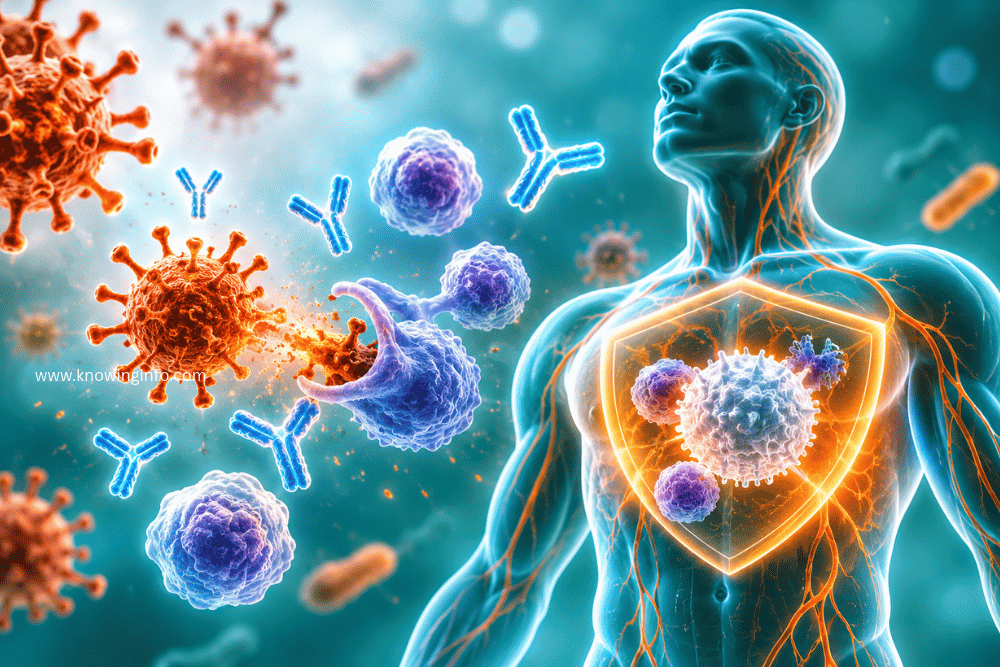
Trillions of pathogens like viruses, bacteria, fungi, and parasites attempt to make your body their very own dining table at each passing minute. You touched the subway rail, inhaled an infected cough, or pricked yourself on a cardboard box, but you wake up one morning perfectly fine.
Have you ever wondered why that is and what goes on inside the human body without your knowledge to keep you alive and well? Your body is not like a delicate card house; it is a safe biological fortress guarded by billions of highly specialized cells that communicate instantly.
In this blog post, we are going to tell you all about these different layers of the inner army and help you understand the science of immunity.
Key Takeaways
- The body defends itself using mechanical barriers, innate cell responses, and adaptive hunting cells.
- B and T lymphocytes produce antibodies that are specific to the pathogen, along with memory cells.
- Inflammation and elevated body temperature are defensive actions that help heal tissues faster.
- Cytokines and antigens help guide the white blood cells to the site of the infection.
- Good sleeping habits and physical activity help lay the physiological groundwork for your immune cells.
The First Line of Defense: Physical and Chemical Barriers
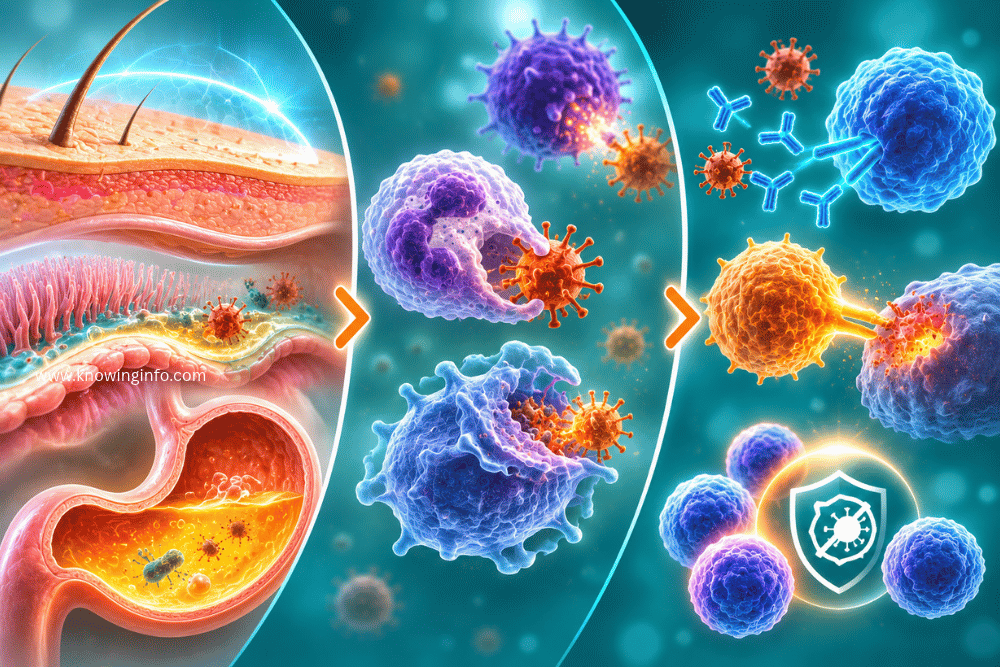
The body defends itself from virtually all infections, preventing the infection from penetrating any live cells by using mechanical barriers with chemical agents to kill off any external threats. It is common for those asking about how the immune system works to overlook the physical barriers:
- Epidermis: Skin is slightly acidic (pH 4.5-5.5) and covered with hard keratin, which forms an arid environment not suited to the invading bacteria.
- Mucociliary Escalator: The respiratory system has a sticky mucus coating that captures the ingested spores and bacteria, which are then swept out via tiny hairs (cilia).
- Antibiotics in your body: Hydrochloric acid (pH 1.5-2.0) present in the stomach kills the ingested pathogens, and tears and saliva have enzymes named Lysozymes that destroy the bacteria’s cell wall.
When the invader breaks into the body via a paper cut or an abrasion wound, this outer layer alerts the cells waiting just below the surface to attack.
Innate Immunity: The Immediate Response Strike Force
Your innate immune system functions as your emergency dispatcher, sending general defensive cells such as neutrophils, macrophages, and natural killer cells within minutes of any breach to consume pathogens and cause local inflammation.
To understand how the immune system works during a cut, observe how quickly the neutrophils respond. Neutrophils, which can be termed “suicide bombers,” quickly move to the injured site to engulf bacteria and then explode.
Following these cells are macrophages, which are big clean-up machines. However, macrophages do not simply eat the debris from the cells; they serve as intelligence agents as well. They carry fragments of the destroyed enemy protein (antigens) and bring them back to the lymph nodes in order to activate the second half of your defense mechanism.
Adaptive Immunity: The Specialized Assassins
Adaptive immunity uses a precise approach to target certain pathogens through the use of B cells that produce customized antibodies and killer T cells that kill off the infected host cells.
This brings us to the main point: How does the immune system function through years of seasonal germs? As innate immunity gives us some breathing space, adaptive immunity provides a specific solution:
- Helper T Cells (CD4+): The generals who recognize the threat and send out chemical signals (cytokines) to direct the attack.
- B Lymphocytes: Tiny factories that manufacture antibodies—Y-shaped proteins that are designed to latch on to the exact structure of a particular virus or toxin and render it harmless.
- Cytotoxic T Cells (CD8+): Professional killers that patrol your own body cells. When a cell becomes infected with a virus inside, the CD8+ cell makes it commit suicide (apoptosis).
After the fight is won, some of these warriors turn into Memory B and T cells. These cells are able to live in your bone marrow and lymph tissues for years, which is why, while studying the workings of the immune system, you discover that you do not often fall ill from the same strain twice.
How Does the Immune System Work to Coordinate Inflammation?
Inflammation helps in the quick supply of healing materials through the swelling of blood vessels, making their walls more permeable, and using certain chemicals such as histamine and cytokines that direct the immune cells to the injured area.
When you accidentally kick your toe or get infected by a chest cold, you will notice the presence of warmth, redness, and swelling. This does not mean that your body is not working; instead, it is proof that your immune system is working actively.
The mast cells produce histamine, which causes the capillaries to dilate. The dilation ensures that defensive fluids, clotting factors, and white blood cells can escape the bloodstream and enter the injured tissue directly.
If you have a fever, then the hypothalamus raises your body’s core temperature deliberately. This increase in body temperature will slow down the reproduction of bacteria and speed up the movement of white blood cells.
Practical Habits That Support Your Biological Defenses
An effective immune response needs enough deep sleep for cytokines, proper micronutrients, exercise for moving lymphatic fluid, and stress reduction.
While you can’t “supercharge” your immunity with emergency packets of sugar, knowing how the immune system works will help you give the ingredients that your white blood cells need to work effectively:
- Get 7–9 Hours of Sleep: Slow-wave deep sleep promotes the secretion of cytokines and increases T-cell receptor binding efficiency.
- Supply Enzymes With Nutrients: Important micronutrients such as zinc, vitamin D3, and vitamin C act as direct cofactors for the generation of antibodies and phagocytes.
- Stimulate the Flow of Lymph: The lymphatic system does not have a pump organ like the heart, and it uses the contraction of skeletal muscles to remove trash.
- Control Chronic Cortisol: Chronic stress produces high amounts of cortisol in the blood that inhibit the generation of white blood cells.
Understanding the workings of the immune system at the cellular level shows how consistency in basic practices always triumphs over a short-term fix.
Bottom Line
The defense mechanism that protects your body is one of the most advanced systems created by nature. From the acid layer covering your skin to the exact targeting mechanism of memory T cells, millions of actions take place each second just to ensure you breathe comfortably.
Learning about how the immune system works does not only mean learning biological information. It also means respecting the hardworking machinery working inside your veins. Respect this army by feeding it, allowing it to rest and taking care of it on a daily basis.
FAQ’s
1. What are the Main Parts that Make Up the Immune System?
The immune system consists of physical barriers (skin and mucus), chemical deterrents (stomach acid and saliva enzymes), cellular defenders (phagocytes, T cells, and B cells), and the lymphatic system (lymph nodes, spleen, bone marrow, and thymus).
2. How Does the Immune System Tell Good Cells From Bad Invaders?
All cells contain unique surface proteins known as the Major Histocompatibility Complex (MHC). The immune system cells continuously monitor these antigens, and if a cell displays any unknown or modified antigen, it is instantly marked for destruction.
3. Why Do Lymph Nodes Swell Up When You Get an Infection?
Lymph nodes act as localized military command centers. When an infection takes place, white blood cells multiply rapidly inside the nodes to build up an army of antibodies, causing noticeable tenderness and swelling.
4. What is the Difference Between an Autoimmune Disease and an Allergic Reaction?
Allergies result from your immune system reacting to something that is essentially harmless outside your body, such as pollen or peanuts. Similarly, an autoimmune disease results from your immune system attacking your body’s own normal healthy cells.
5. How Does Vaccination Train Your Natural Defenses?
A vaccine introduces you to a non-harmful version of a virus. In this way, your adaptive immune system develops antibodies and memory cells in a safe environment without getting sick.